

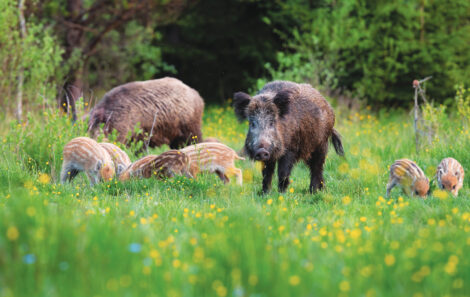
Discover how to trap wild hogs with these innovative solutions for invasive species population balance.
Armored catfish, Eurasian boar, garlic mustard, red swamp crayfish, and wakame seaweed are all invasive species in the United States. Farms and chefs across the U.S. are fighting back by eating them. While we likely can’t eat our way out of this human-made problem, it could be a tasty beginning to a solution.
Problematic Pigs
Since the 1500s, settlers and explorers purposely and accidentally released Eurasian boars into the American ecosystem as a food source. Also known as “feral hogs,” “wild pigs,” and “razorbacks,” these non-native swine cause huge problems to agriculture, health and public safety, natural resources, and more.
Wild pigs are a growing problem across the U.S., with massive populations of approximately 1.5 million in Oklahoma and 3 million in Texas, and an estimated 8 million across the country.
“A female can raise up to 24 pigs yearly,” John Wesley Whitfield says. Whitfield is the large game guide at The Farm at Okefenokee. “The pigs start breeding as early as 4 months [old] if they have a high-quality food supply. If they’re in good woods where there’s a lot of roots or if hunters are throwing out corn throughout hunting season, it makes the hogs healthy.”
“They have exponential growth,” explains Doug Davis, co-founder of The Farm. “My guess is that, through maybe the industrial revolution, they were hunted as food and therefore kept in check by being a major food source in the early days.”
Davis recalls that over 20 years ago, when he was working in Savannah, Georgia, a Department of Natural Resources agent, while walking a site, asked whether he hunted on the property for hogs.
“I was worried that she’d be mad if there were people using the property [to hunt]. And so, instead of saying yes, I asked why. She said, ‘Because if you aren’t hunting out here, you need to. These feral hogs are going to absolutely destroy the ecosystem.'”
If populations are left unchecked, wild pigs and their rooting behavior can turn an acre of land into a muddy, useless mess in a handful of days. Whitfield says, “The woods are nature’s grocery store, and there are only so many acorns. The deer can’t eat as fast as a herd of hogs.”
Davis says, “You can have an oak hammock that’s been largely [undisturbed] for hundreds of years, with 18 inches of unpacked topsoil. Then, when the feral pigs get in there, within an evening or two, they completely destroy [all of those] years of work on topsoil.”
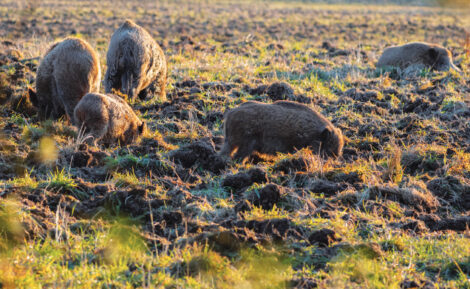
According to the U.S. Department of Agriculture (USDA), this rooting can “shift the tree species diversity and density in a forest … since they’re huge consumers of mast crops (acorns, hickory nuts, beech nuts, and tupelo).” The USDA also notes that the wallowing activity increases erosion, especially in wetlands, and can limit water infiltration and nutrient cycling. It’s estimated that feral swine damage and control costs $2.5 billion each year in the U.S. agriculture sector alone.
On top of all of that, some invasive plant species – such as carpet grass – now benefit from the hogs’ destructive habits, as these plants do well in freshly disturbed areas and are excellent at colonizing new niches quicker than native flora.
Swine Solutions
On farms throughout the U.S., people have turned to trapping wild boar, feeding them for a couple of months, and then harvesting them. This may help reduce the invasive boar population while also providing quality food for families and communities.
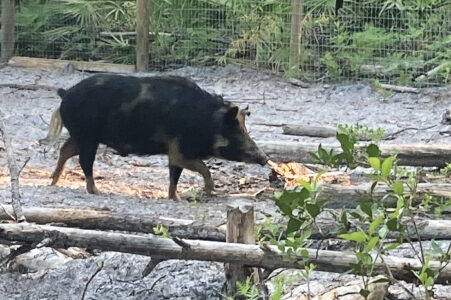
With dogs and manpower, Davis and his team relocate hogs to a 1-acre fenced area located on The Farm. They only cleared enough of the wooded lot to securely add a perimeter fence. The inside of the pen consists of intact woods so thick that Davis says you sometimes can’t see the hogs in the pen. The wooded enclosure provides the hogs with a feeling of protection and privacy.
Pigpen Plans: Wild Boar Edition
Whitfield recommends having your pen’s posts closer together than in a domestic hog setup, as the hogs can grow into huge and powerful animals. Posts should be secured every 5 feet or so, and the fence height should also be 5 feet or higher. “I’ve seen ’em almost climb out of a horse stall,” Whitfield says. “They can jump, and they can jump high.”
A system to prevent escape under the pen is also essential. The Farm attaches a fence panel on the ground to the vertical fence, so if the hogs try to root out, their own weight keeps the fence panel in place.
Grow-out times vary based on the initial condition of the pigs and The Farm’s needs. Currently, they have 10 pigs in the 1-acre lot, but that can change through acquisition and consumption. In a single year, they’ve caught up to 80 pigs. The lot can house dozens of wild pigs at a time, as The Farm supplements the pigs’ feed with corn, leftover harvest, and kitchen scraps.
Unlike some other wild-hog-to-table operations, The Farm doesn’t separate the boars and sows, since the pigs will only be in the grow-out pen for a short time. The boars are additionally castrated for population control, just in case they escape, and for taste. The ideal weight at time of harvest is 125 to 150 pounds, but some hogs are initially caught at 300 pounds. Smaller pigs can be butchered to make sausage, or one large boar could be prepared for a community barbecue.
Wild Boar Flavor
“You know, I love to cook, and if Wesley has butchered out a hog for me, and if it’s been treated right – which is key to any wild game – I think it’s superior, because it has a deeper flavor profile,” Davis says. “I’d much rather have that than pork from the industrial food chain all day long, every day, seven days a week.”
Davis says that if you’re looking for a pretty cut of meat, you’re not going to get that on a wild animal. But he shares that the flavor is exceptional compared with domestic animals, which are often kept lean and swollen and aren’t a good representation of what pork can be. “I love wild hogs, and I often braise them at low heat for a longer period of time.”
Whitfield proudly adds that the sausage is made locally in Georgia at Wainright & Son Sausage Company. “Anytime I’ve ever taken a hog there – even a boar hog without being castrated – I’ve gotten good sausage, with no smell.”
How to Avoid Boar Taint
The “smell” Whitfield is talking about is called “boar taint” and is deeply unappealing. Boar taint is the accumulation of two compounds: androstenone and skatole, with androstenone being associated with sex pheromones that accumulate in the fat of sexually mature males. These compounds cause the meat of some uncastrated males to smell foul and of urine.
Whitfield estimates that it’s a 50-50 chance of catching a pig with boar taint. Just recently, Davis and Whitfield caught and harvested a 285-pound boar in the wild that had no boar taint attributes. Davis questioned why they weren’t taking it back to The Farm to castrate it and feed it out, and Whitfield said there was no need. He was right. Some of that pork is sitting in Davis’ freezer right now. Other times, they’ll find a small, unremarkable boar that reeks of boar taint.
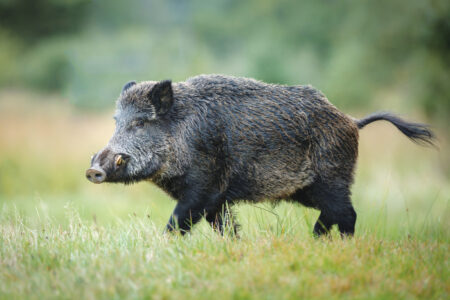
“You grab [the pig], and you can smell it on your hands two days later, even after you’ve bleached them,” Whitfield says.
The solution? Capture the boar, castrate it, and feed it out for a minimum of a month, and that smell will go away.
Not So Boaring
With exploding population numbers, eating wild pigs seems like one solution to combat these destructive, invasive creatures. It’s a lot of effort, but you’ll end up with delicious, local food, and you’ll help the environment at the same time.
Wildlife Services
To learn more about the problems caused by this invasive animal, or to seek advice and assistance, call the USDA-APHIS Wildlife Services program in your state at 1-866-487-3297, or go to www.Aphis.USDA.gov/Operational-Wildlife-Activities/Feral-Swine/Program.
Wild pigs can be dangerous. They can run approximately 30 mph and jump about 3 feet off the ground. Both males and females have sharp tusks (with the males’ tusks being longer and sharper), and they’re capable of breaking bones with a bite. Wild hogs can cause severe injury or death to humans if they feel threatened.
If you intend to hunt or trap wild hogs, go with an experienced hunter, and never hunt alone. – Mother
Doug Davis’ Wild Hog Recipe
This recipe can be eaten as a simple stew, served over rice, or as barbecue, or, for a more decadent flavor, add cream and raw sweet peas at the last minute and serve it with rigatoni.
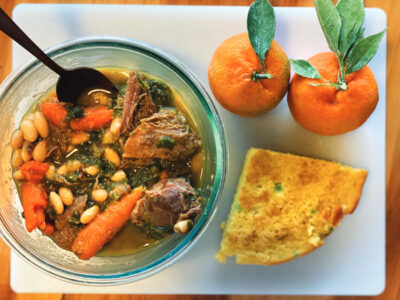
Ingredients
- Wild hog ham, shoulder, or shank
- 2 large onions, chopped
- 2 carrots, chopped
- 2 bay leaves
- Rosemary
- Thyme
- 2 to 5 garlic cloves
- Brown the meat in a Dutch oven on the stovetop to begin rendering fat.*
- Once browned, remove the meat and leave the drippings. Add vegetables and bay leaves.
- Deglaze, and then fill Dutch oven at least halfway with hog meat. Add herbs and garlic.
- Cover with foil and replace heavy lid. Cook at 225 F for 6 to 8 hours.
*Wild hogs don’t have as much fat as domestic pigs. The average per serving is about 2.8 grams, compared with 7.7 grams in domestic swine.
Kenny Coogan has a master’s degree in global sustainability, and he co-hosts the “Mother Earth News and Friends” podcast, which can be enjoyed at www.MotherEarthNews.com/Podcast. He also created and hosts the TV show “Florida’s Flora and Fauna with Conservationist Kenny Coogan.” To learn more about that program, visit www.FloridasFloraAndFauna.com.
Originally published in the October/November 2025 issue of MOTHER EARTH NEWS and regularly vetted for accuracy.





